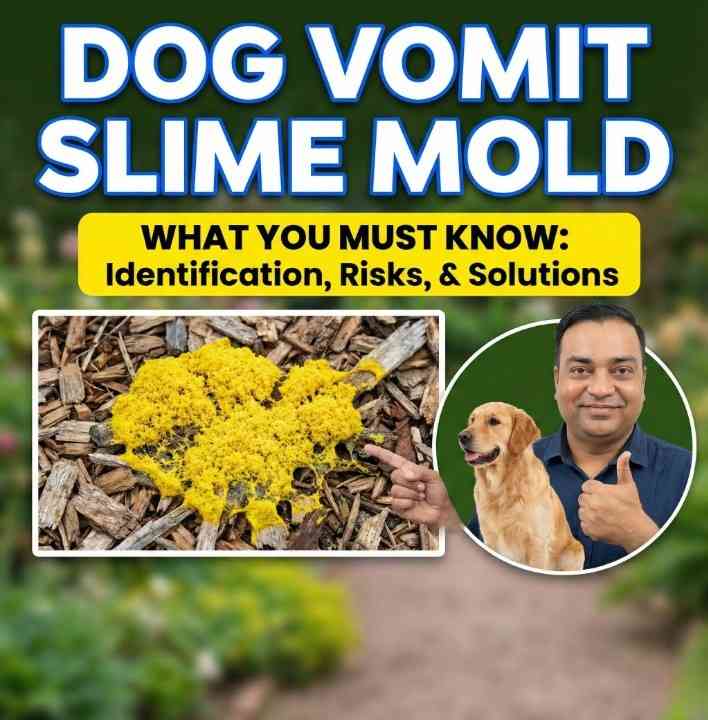
Being a veterinarian, it is among the most frequent calls that I get during the rainy season a concerned pet owner’s call that goes like this: “A yellow and slimy thing that looked like it came from my dog has been lying in my garden overnight, did my dog throw up?”
The answer, in nearly every case, is dog vomit slime mold.
Despite the horrible name and the ugly look, the organism is quite a bit less scary than it seems. It is very helpful for animal owners to know the reasons of dog vomit slime mold, its formation, and the risk it might be to their pets.
Table of Contents
1. Introduction
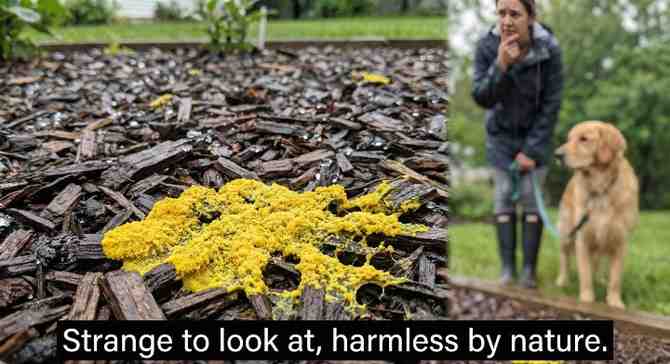
Dog vomit slime mold appears suddenly and attracts immediate attention, and not causing any fuss, especially dams, where it might become a reason for harassing dogs. Although it looks like some kind of food that has been thrown up or fungi rapidly growing, it has nothing to do with dogs, nor is it a disease indication.
This article delves into biology, origin, risk, and handling of dog vomit slime mold from vet and nature point of view.
2. What Is Dog Vomit Slime Mold
Dog vomit slime mold is a slime mold, which is scientifically named Fuligo septica.
Although the term “mold” is used, it is not a fungus of the regular kind. It is a member of a very different set of life forms, protists, which are different in behavior from the four major kingdoms, plants, animals, and fungi.
Key Features:
- Lives primarily in soil and decaying plant matter
- Feeds on bacteria and microorganisms
- Plays a role in natural decomposition
Due to its yellow, foamy appearance it earn its unpleasant name.
3. Is It a Fungus, Mold, or Something Else?
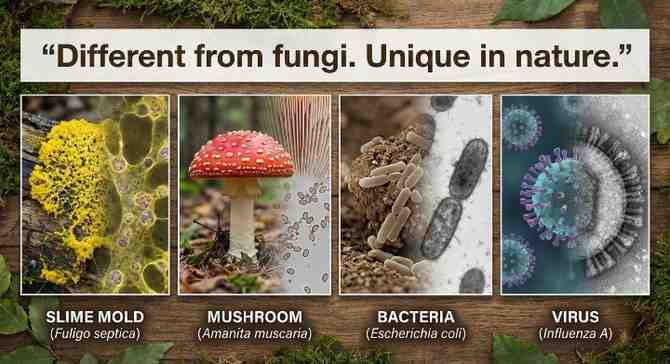
From a biological standpoint, slime molds are:
- Not fungi (they do not have fungal cell walls)
- Not bacteria
- Not parasites
They are free-living organisms that move and feed independently.
This distinction is important because it explains why fungicides usually do not work against them.
| Feature | Slime Molds | Fungi | Bacteria | Viruses | Parasites |
|---|---|---|---|---|---|
| Biological Group | Protists | Fungi kingdom | Prokaryotes | Acellular agents | Animals or protozoa |
| Cell Type | Eukaryotic | Eukaryotic | Prokaryotic | Not cells | Eukaryotic |
| Living Status | Free-living organism | Living organism | Living organism | Not truly living | Living organism |
| Needs a Host? | No | No | No | Yes (mandatory) | Yes (for survival) |
| Mode of Nutrition | Feeds on bacteria & organic matter | Absorbs nutrients from matter | Diverse (self-feeding or parasitic) | Uses host cells | Feeds on host |
| Movement Ability | Can move (amoeba-like) | No movement | Limited (flagella) | No movement | Usually mobile |
| Reproduction | Spores | Spores | Binary fission | Replication in host | Sexual or asexual |
| Visibility | Visible to naked eye | Visible | Microscopic | Microscopic | Micro or macro |
| Pathogenic to Humans/Pets | Rarely | Some species | Some species | Yes | Yes |
| Environmental Role | Decomposition & nutrient recycling | Decomposition | Nutrient cycling & disease | Disease transmission | Disease & host interaction |
| Example | Dog vomit slime mold | Mushrooms, yeast | E. coli | Rabies virus | Ticks, worms |
4. Physical Characteristics
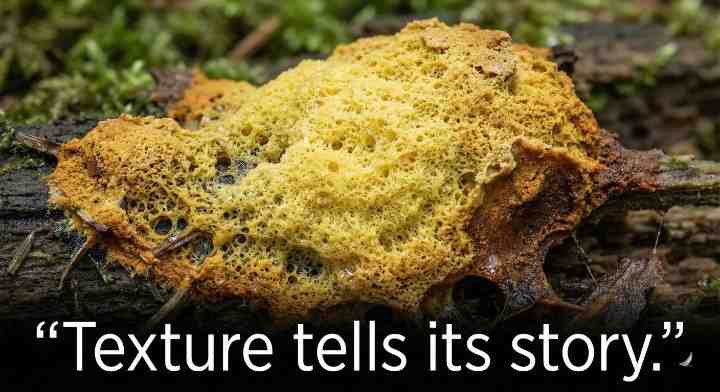
Dog vomit slime mold is easily recognized by its appearance.Slime molds are highly dynamic organisms whose appearance can change dramatically in a short time, which is why they often surprise homeowners when they appear suddenly.
As it dries, it may turn brown or powdery, signaling the release of spores.
| Characteristic | Description |
|---|---|
| Color | Commonly bright yellow, cream, orange, white, or brown depending on species and stage |
| Texture | Slimy, foamy, gelatinous when active; dry and powdery when mature |
| Shape | Irregular, blob-like, or network-shaped mass |
| Size | Ranges from a few centimeters to over 30 cm in diameter |
| Surface Appearance | Smooth, bubbly, or sponge-like |
| Movement | Slowly creeps using amoeba-like motion |
| Moisture Content | High moisture during active stage; dries with age |
| Structural Body | Single large mass (plasmodium) with no fixed body parts |
| Visibility | Easily visible to the naked eye |
| Odor | Usually odorless or mildly earthy |
| Change Over Time | Rapid changes in color, size, and texture within days |
5. Where Dog Vomit Slime Mold Is Found
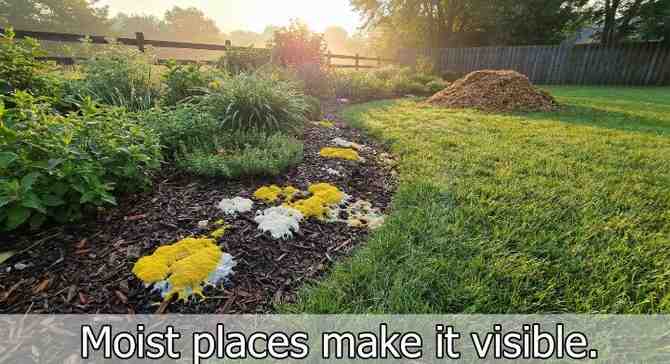
It is almost exclusively found outdoors, commonly in:
- Mulch beds
- Lawns with high organic debris
- Wood chips and bark
- Compost piles
- Damp shaded areas
It does not grow indoors under normal household conditions.
6. Environmental Conditions That Favor Growth
Several environmental conditions contribute to this:
| Environmental Factor | How It Supports Growth |
|---|---|
| High Moisture | Provides the water needed for slime mold to become active and expand |
| Warm Temperature | Speeds up growth and movement of the organism |
| High Humidity | Prevents drying, allowing slime mold to remain active longer |
| Decaying Organic Matter | Supplies bacteria, which are the main food source |
| Shaded Areas | Reduces evaporation and maintains moisture |
| Poor Drainage | Keeps soil damp for extended periods |
| Mulch or Wood Chips | Retains moisture and organic nutrients |
| Recent Rainfall | Triggers rapid emergence from dormant spores |
| Low Air Circulation | Slows drying of soil and surfaces |
| Nutrient-Rich Soil | Encourages microbial growth that slime molds feed on |
From a veterinary environmental health perspective, slime mold growth is a sign of specific environmental conditions, not neglect.
Heavy rain followed by warm weather creates ideal conditions.
7. What Causes Dog Vomit Slime Mold (Fuligo septica)
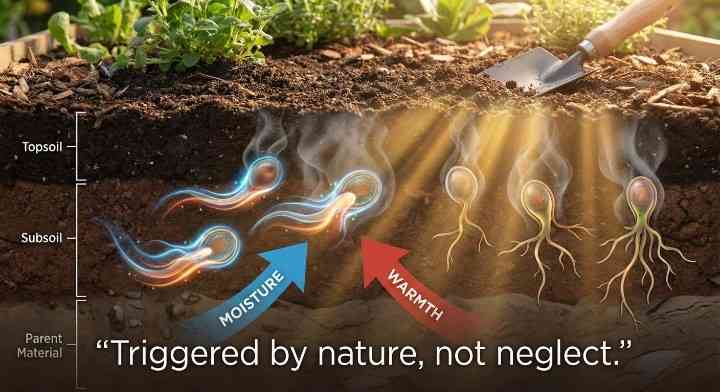
Dog vomit slime mold forms due to the interaction of moisture, warmth, organic decay, and microbial availability, not because of animals, disease, or contamination. Its appearance represents a natural stage in the slime mold life cycle.
The causes are completely environmental, not biological contamination.
| Causative Factor | Scientific Explanation |
|---|---|
| Dormant Spore Activation | Spores present in soil germinate when environmental conditions become favorable |
| High Moisture Availability | Water allows spores to develop into active plasmodium capable of movement |
| Warm Ambient Temperature | Enhances metabolic activity and cellular movement |
| Decaying Organic Material | Provides bacteria and microorganisms that serve as food |
| High Microbial Population | Increased bacterial density supports rapid growth |
| Mulch and Wood Debris | Retains moisture and organic nutrients |
| Soil Compaction | Reduces drainage, maintaining damp conditions |
| Poor Air Circulation | Slows drying and prolongs active phase |
| Recent Rainfall Events | Triggers rapid surface emergence of plasmodium |
| Natural Life Cycle Progression | Plasmodium migrates to surface to form sporangia and release spores |
Slime mold thrives where bacteria are abundant, because bacteria are its food source.
8. Life Cycle of Dog Vomit Slime Mold
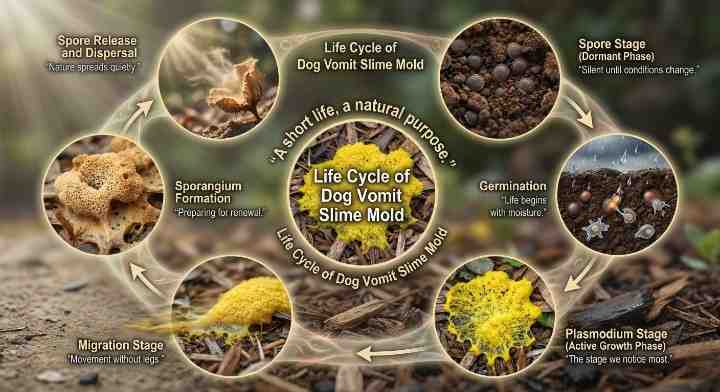
Understanding its life cycle explains why it appears so suddenly.
The visible phase usually lasts only a few days.
1. Spore Stage (Dormant Phase)
- Microscopic spores remain inactive in soil or organic debris
- Can survive for long periods under dry or unfavorable conditions
2. Germination Stage
- Spores germinate when moisture and warmth are present
- Release amoeba-like cells or swarm cells
3. Plasmodium Stage (Active Growth Phase)
- Cells fuse to form a large, visible, slime-like mass
- Actively moves and feeds on bacteria and organic matter
- This is the stage commonly seen on lawns and mulch
4. Migration Stage
- Plasmodium moves to exposed surfaces
- Prepares for reproduction under suitable conditions
5. Sporangium Formation (Reproductive Phase)
- Slime mold dries and hardens
- Forms spore-containing structures
6. Spore Release and Dispersal
- Mature spores are released into the environment
- Spores spread through wind, water, or animals
9. Why It Appears Overnight
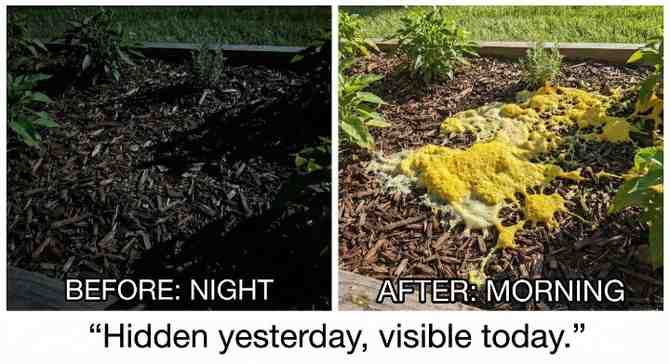
Pet owners usually panic because the growth appears overnight and looks alarming.
In reality, the organism was present underground and when conditions are favourable they became visible.
Rapid moisture absorption allows the plasmodium to expand quickly, making it noticeable within hours.
10. Is Dog Vomit Slime Mold Harmful to Dogs
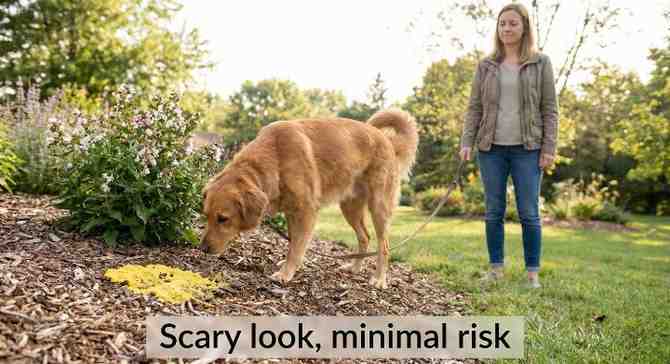
In routine veterinary practice, this is considered as a most important question.
In most cases, it is not toxic.
However:
- Dogs should not be encouraged to eat it
- Mild gastrointestinal upset may occur if ingested
- Curious puppies are at higher risk of tasting it
Serious poisoning is extremely rare.
11. Possible Symptoms if Slime Mold Ingested By Dog
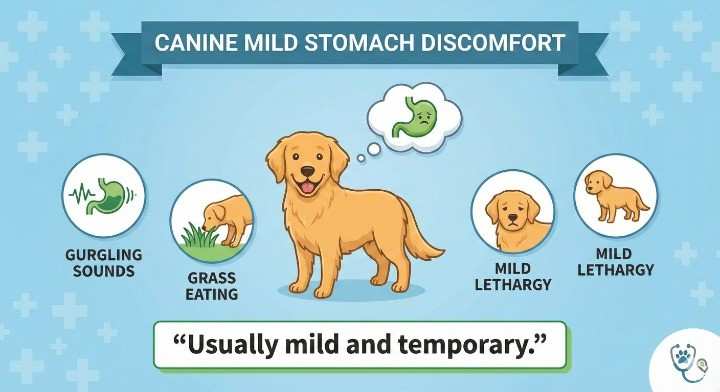
If a dog consumes slime mold, potential signs include:
| Symptom | Explanation |
|---|---|
| Vomiting | Mild stomach irritation may trigger short-term vomiting |
| Drooling (Hypersalivation) | Oral irritation or unpleasant taste stimulates saliva production |
| Nausea | Temporary gastrointestinal discomfort |
| Loss of Appetite | Reduced interest in food due to stomach upset |
| Lethargy | Mild discomfort may cause reduced activity |
| Diarrhea (Rare) | Occasional digestive upset in sensitive dogs |
| Gagging or Pawing at Mouth | Reaction to unusual texture or taste |
If symptoms persist beyond 24 hours, visit nearest veterinary clinic.
12. Risks to Humans
Dog vomit slime mold is not considered dangerous to humans.
It does not infect skin or lungs and does not produce known toxins under normal conditions.
Basic hygiene—such as wearing gloves during removal—is sufficient.
13. Impact on Lawns and Plants
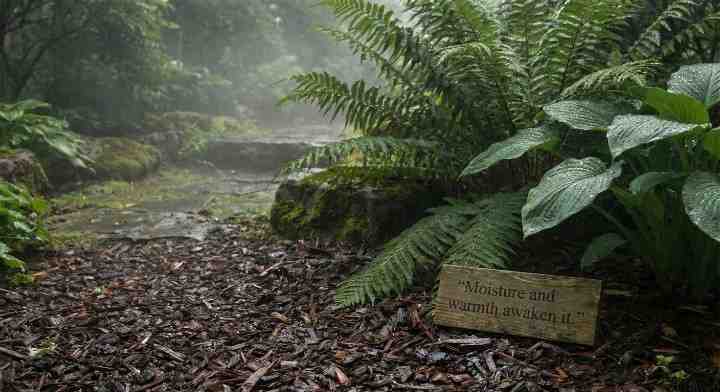
Although unsightly, slime mold:
- It does not kill grass or plants
- It may temporarily block sunlight
- It can flatten grass underneath
Once removed or dried, the lawn typically recovers quickly.
14. Common Myths and Misconceptions About Slime Mold Infection in Dogs
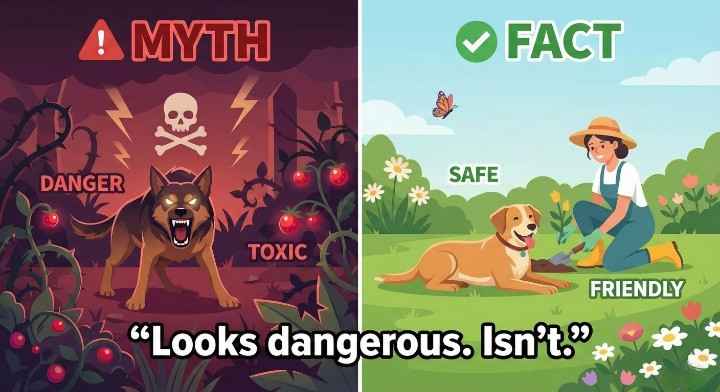
| Myth or Misconception | Scientific Reality |
|---|---|
| Slime mold infects dogs | Slime molds do not infect animals and are not parasitic |
| Dogs get fungal disease from slime mold | Slime mold is not a true fungus and does not cause fungal infections |
| Contact causes skin disease | Simple contact does not cause skin problems in dogs |
| Slime mold is highly toxic | Commonly it is non-toxic; ingestion may cause mild stomach upset only |
| It spreads from dogs to humans | Slime mold is not contagious |
| Presence means dirty or unhealthy yard | It indicates moist, organic-rich soil, not poor hygiene |
| Fungicides are required to kill it | Fungicides are ineffective and unnecessary |
| It will permanently damage lawns | Any effect on grass is temporary |
| Dogs must be treated after exposure | Treatment is not needed unless symptoms occur |
| It is caused by dog vomit or waste | The name is misleading; it has no link to animals |
15. How to Identify Dog Vomit Slime Mold

Identification is usually visual:
- Bright yellow or tan foamy mass
- Appears after rain
- Located on mulch or organic matter
Laboratory testing is rarely necessary.
16. When to Seek Expert Advice
Consult a professional if:
- Growth persists repeatedly in large quantities
- Pets show recurring illness
- You suspect a different type of mold
In most cases, reassurance is all that is needed.
17. Prevention Strategies
While you cannot eliminate slime mold entirely, you can reduce recurrence.
Preventive steps:
- Avoid overwatering lawns
- Rake excess organic debris
- Turn mulch periodically
- Improve drainage
- Use thinner mulch layers
18. Removal and Control Methods
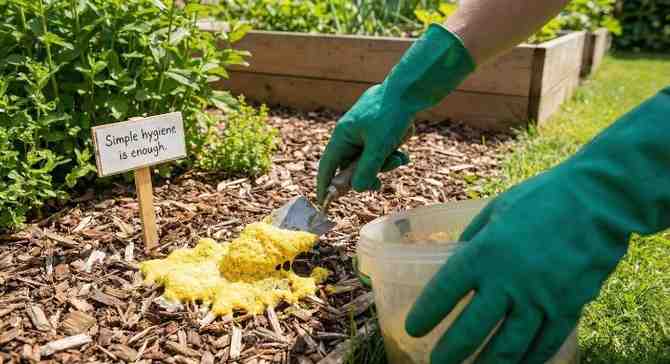
Manual removal is usually sufficient.
Recommended methods:
- Scoop and dispose with gloves
- Hose lightly once dried
- Rake affected mulch
Chemical treatments are not recommended and often ineffective.
19. What Not to Do
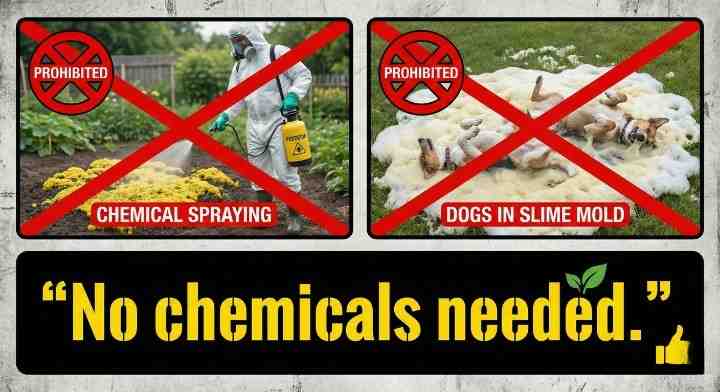
Avoid:
- Spraying fungicides
- Panic-driven soil replacement
- Allowing pets to play in fresh slime mold
These measures are unnecessary and ineffective.
20. Long-Term Management
From a sustainable standpoint, slime mold is part of a healthy ecosystem.
Its presence suggests active soil biology, not neglect.
Balanced lawn care is the best long-term solution.
21. Summary
Dog vomit slime mold might scare you, but it is an absolutely safe and temporary nature, loving organism.
The reason for its appearance is that a combination of moisture, warmth, and rotting organic matter has been found, definitely not diseases, pets, or contamination.
As for pet owners, the main thing here is understanding the situation, taking it off easily, and preventing it in a simple way rather than being frightened.
FAQs
What exactly is dog vomit slime mold?
Dog vomit slime mold is a naturally occurring slime mold (Fuligo septica) that grows on damp soil and mulch. It is not related to dogs or vomit despite its appearance.
Why does it look like my dog threw up?
Its foamy, yellow texture resembles regurgitated food, which is how it got its name. The appearance is misleading and purely coincidental.
Is dog vomit slime mold dangerous for dogs?
No, it is generally harmless. However, ingestion may cause mild stomach upset, so dogs should be discouraged from eating it.
Can dog vomit slime mold make humans sick?
It does not cause illness in humans. Normal hygiene practices, such as wearing gloves during removal, are sufficient.
Why does dog vomit slime mold appear overnight?
It develops rapidly when moisture and warmth activate dormant spores, causing visible growth within hours.
Does its presence mean my lawn is unhealthy?
No. It often indicates moist, organic-rich soil, which can actually be a sign of active soil biology
Should I remove dog vomit slime mold immediately?
Removal is optional. It usually dries and disappears on its own within a few days, but can be removed for aesthetic reasons.
Will fungicides kill dog vomit slime mold?
Fungicides are ineffective because slime mold is not a true fungus and does not respond to these treatments.
Can my dog get infected by touching it?
No. Slime mold does not infect animals and cannot spread disease through contact.
How can I prevent it from coming back?
Reduce moisture, avoid overwatering, improve drainage, and manage mulch thickness to make conditions less favorable for growth.

Very informative